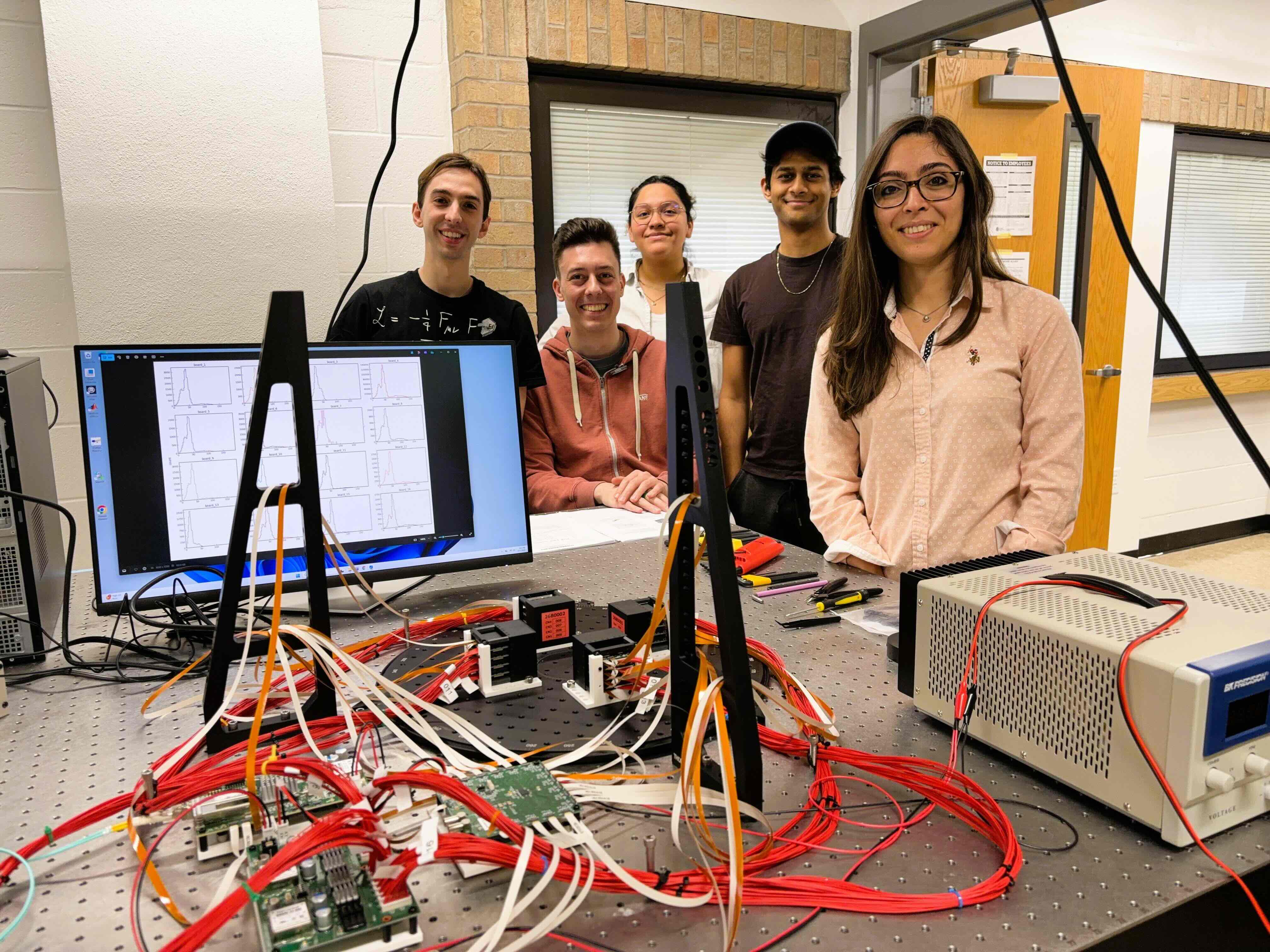
The Translational Radiological Advanced Imaging Laboratory (TRAIL) in the Nuclear and Radiation Engineering Program within the Walker Department of Mechanical Engineering has been awarded a R21 Trailblazer Award from the National Institute of Biomedical Imaging and Bioengineering (NIBIB) of the National Institutes of Health (NIH). The grant will support the development of a novel, robot-assisted SPECT (Single Photon Emission Computed Tomography) imaging system, a project that seeks to redefine how high-resolution functional images of the human body are acquired.
This project is a collaboration between the Nuclear and Radiation Engineering Program, Texas Robotics, and Stanford University School of Medicine. By integrating collaborative robotic manipulators with advanced semiconductor radiation detectors, the team aims to move beyond the constraints of traditional stationary imaging gantries.
"This award provides an opportunity to rethink the architecture of nuclear imaging systems" said Dr. Elena M. Zannoni, the project's lead investigator. "By utilizing robotic arms for full 3D positioning, we can create a truly adaptive platform that provides high-sensitivity imaging for organ-specific applications as well as emerging ones like radiotheranostics."
The Trailblazer Award is specifically designed for new and early-stage investigators to pursue high-impact, high-risk research programs that integrate engineering and the physical sciences with the life sciences. The three-year project will focus on the design and validation of a flexible robotic arm system capable of 3D dynamic positioning, allowing for imaging configurations that were previously impossible with conventional hardware.